

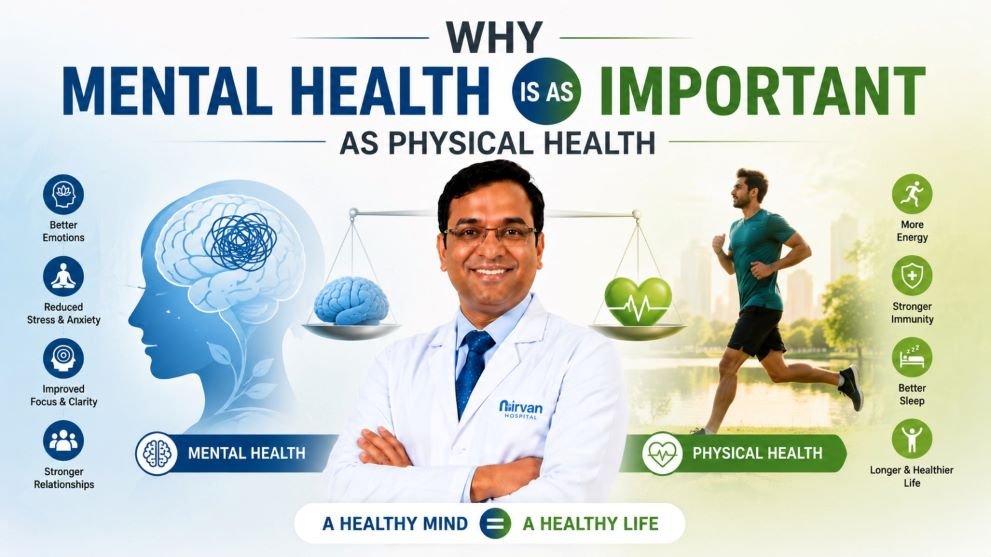
Why Mental Health is as Important as Physical Health
For a long time, health meant one thing – the body. How strong it was, how well organs functioned, how fast someone recovered from illness.
That’s changed. Mental health matters just as much. The two aren’t separate systems – they’re the same system, constantly affecting each other. You can’t treat one while ignoring the other.
Difference Between Physical Health and Mental Health
Physical health is the body side of things. How it performs, how it recovers, whether it’s free from illness or injury. Movement, nutrition, sleep, not ignoring things until they become emergencies.
Mental health is everything happening on the inside. How you process stress. How you relate to people. How decisions get made when things are genuinely difficult. Whether you’re actually present in your life or just getting through days.
Poor mental health erodes the body over time. Poor physical health damages mental clarity and mood. You can’t fix one while completely ignoring the other. That’s not a philosophy. That’s just how biology works.
Reasons Why Mental Health is as Important as Physical Health
To create and maintain healthy relationships- Real communication requires mental stability. So does genuine conflict resolution and actual empathy. These reduce daily stress, provide the kind of social support that directly improves health outcomes, and lower physical disease risk in ways most people never connect back to relationship quality.
To attain better physical health- Depression and anxiety don’t stay contained. They worsen physical conditions, raise disease risk, suppress immunity. Mental wellbeing does the opposite – making healthy choices feel possible rather than impossible, reducing the biological accumulation that eventually shows up as illness.
To attain a positive self-image- People who feel mentally well tend to take better care of themselves. Not perfectly, but consistently. They exercise more regularly, eat more reasonably, actually see a doctor when something feels wrong instead of avoiding it for six months. That link between internal wellbeing and physical self-care is more direct than most people realize.
To enhance productivity- Your mental state is your concentration, your decision quality, your consistent output. When it deteriorates, work deteriorates. Often more than physical conditions cause. And in ways that are harder to explain to anyone who can’t see what’s happening from the inside.
To cope with stress- Handling stress well reduces real physical health risks – blood pressure, digestive function, immune response. Mindfulness and meditation produce measurable physical changes. Actual clinical measurements shift. Not just a feeling.
To increase retentivity- Good mental health supports memory and cognitive function across the board. That matters practically – following medical routines, making better daily choices, avoiding accidents that happen when focus slips consistently over time.
To live life to the fullest- Mental health is whether you actually enjoy your life. Whether you pursue things that matter to you. Whether you stay genuinely connected to people you care about. Physical health without that is just time passing. The two together are what make it worth it.
How Mental Health Influences Physical Health
Chronic stress keeps the body in an alert state that was never meant to run indefinitely. Cortisol keeps coming. Inflammation accumulates. Blood pressure stays elevated. Immune function runs consistently below where it should be.
Better mental states reverse this. Through actual biological pathways. Measurable changes. Not abstract wellness concepts – things that show up in clinical data.
Final Thoughts
Visible metrics dominate the health conversation now. Numbers, transformations, things you can track and screenshot and post. Emotional wellbeing doesn’t produce content so it keeps getting deprioritized – something to sort out later, once the more concrete things are handled.
Except later keeps not coming. And the inside keeps affecting the outside in ways that eventually become impossible to ignore.
Listening to what you actually feel instead of pushing through indefinitely. Asking for help before things become a crisis. Giving yourself the same consideration you’d give someone else without a second thought. That’s what looking after mental health actually looks like in practice.
Without mental health, there is no health. The research lands in the same place every time. When both are genuinely cared for – mind and body together – that’s where actual wellness is.
Frequently Asked Questions (FAQs)
Can mental health cause physical illness?
Yes. Sustained stress keeps cortisol releasing. Chronic inflammation follows. Sleep gets disrupted. Immune function drops. Over time this directly contributes to serious physical disease – not as a risk factor in the background but as an actual cause.
Does poor mental health affect daily functioning?
More than most people realize from outside. The fatigue is real. The brain fog is real. The motivation collapse is real. These aren’t personality traits – they’re symptoms. Missed work and reduced output follow mental health deterioration in ways that a physical condition would make immediately visible and explainable.
How can I take care of my mental and physical health simultaneously?
Sleep properly. Move regularly. Eat reasonably. Manage stress through mindfulness or actual professional support. Get help early when something feels off rather than waiting until it becomes a crisis. These habits don’t compete – they support each other in both directions.
Where can I learn more or get professional support?
The CDC maintains a dedicated mental health section covering the mind-body connection in real depth. For anything personal, a qualified mental health professional is where actual support comes from rather than general reading.
What is the 3-3-3 rule in mental health?
Grounding technique for acute anxiety or panic. Three things you can see. Three things you can hear. Three things you can physically feel right now. Forces attention back to the immediate environment and breaks the internal spiral. Works anywhere. More effective than people expect before they actually use it.


Alcohol-Free Living: How To Quit Drinking And Improve Your Health
September 29, 2026 - 6:10 am[…] more than only the liver. Frequent or excessive alcohol use can compromise daily activities, physical health, relationships, behavior, sleep and psychological […]