

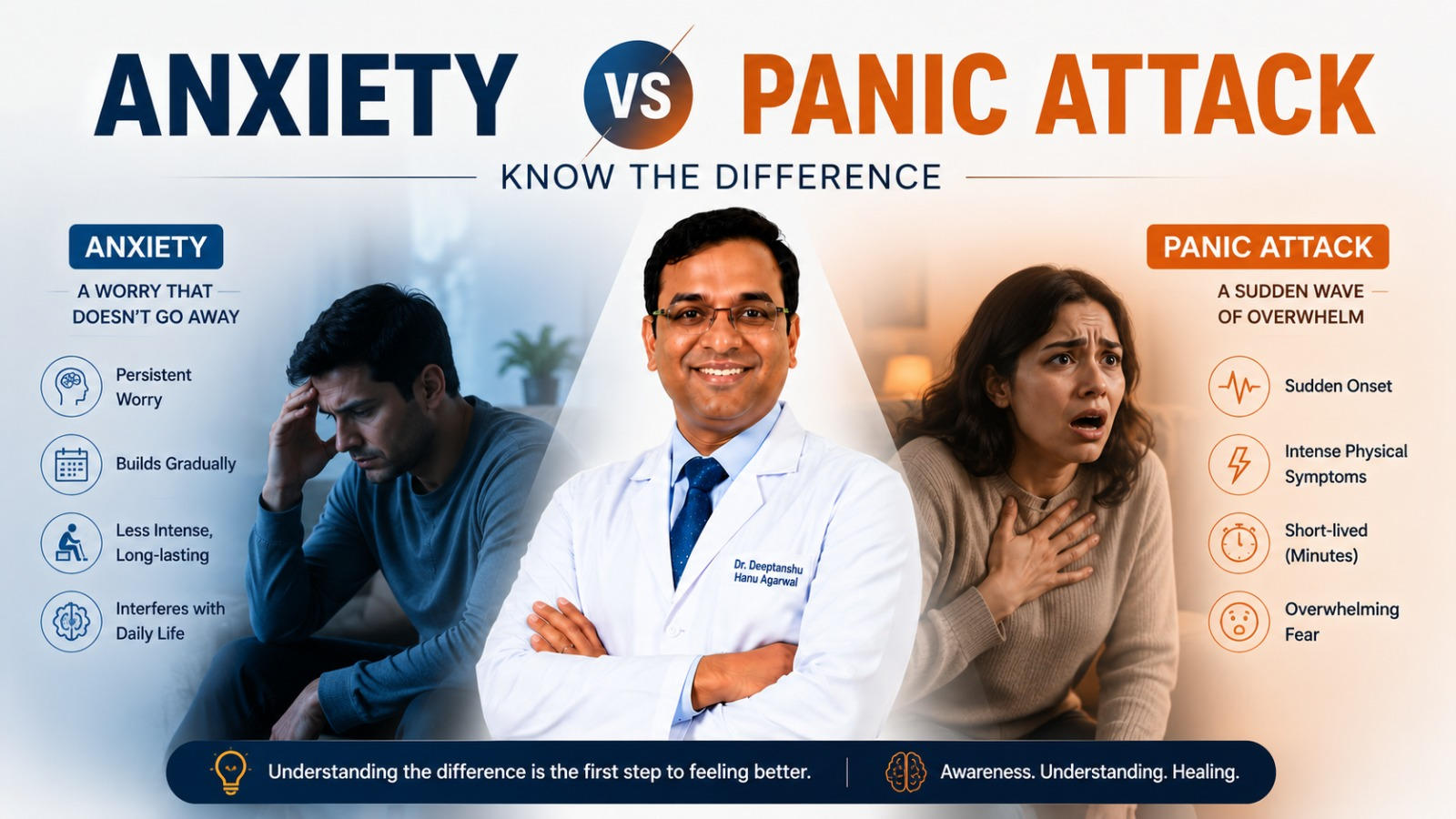
Anxiety vs Panic Attack – Know the Difference
While anxiety and panic attacks are often used interchangeably, they differ significantly in onset, intensity, and duration. Panic attacks are abrupt, intense surges of overwhelming fear and physical symptoms, whereas anxiety is generally a prolonged response to stress or future worries.
Understanding the core differences between the two can help you manage your symptoms more effectively:
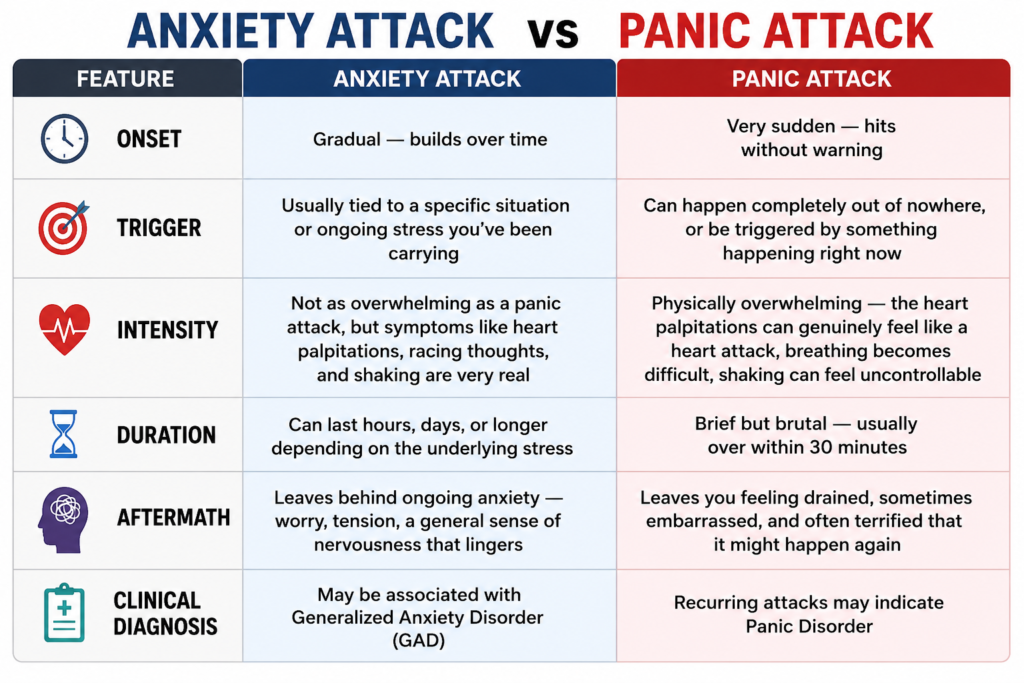
Key Differences Between Anxiety vs Panic Attack
The reason people mix these up is that on a symptoms checklist they genuinely overlap. Racing heart shows up in both. So does sweating, shaking, feeling like something is wrong. But how they arrive, how long they last, and what they actually feel like in your body – that’s where they completely part ways.
Treatment and Medication for Anxiety vs. Panic Attack
One thing worth knowing upfront – there’s no single treatment that covers everything here. What tends to work is a combination of things, adjusted over time depending on how the person is doing and what’s actually helping.
Counseling and Psychotherapy
CBT comes up constantly in this conversation and it deserves to. What it actually does – and this gets lost in the clinical language – is help you build real strategies for when triggers show up, not just an understanding of why they happen. There’s a difference between knowing what sets off your anxiety and having something useful to do when it hits at an inconvenient moment. Cognitive therapy works at a slightly different level, targeting the thought patterns that feed anxiety before it ever becomes a full episode. Exposure therapy is the one people tend to resist because it’s exactly what it sounds like – facing the things that trigger fear, gradually, in a controlled setting. It’s uncomfortable and it works. Relaxation techniques like breathing work, guided imagery, progressive muscle relaxation, biofeedback – these tend to support the other approaches rather than replace them. Individual sessions work better for some people. Others do better in groups. Plenty of people do both at different stages of treatment.
Medication
SSRIs and SNRIs are where most medication conversations start. They’re designed for longer-term use and they genuinely take weeks to reach full effect – something that’s hard to sit with when you’re already struggling. Beta-blockers are more targeted, handling physical symptoms like a racing heart specifically without affecting the psychological side. Benzodiazepines work quickly and effectively but carry a real dependence risk, which is why prescriptions tend to stay short-term. Side effects exist across all of these. Most people’s medication plan shifts at least once during treatment – that’s normal, not a sign something is wrong.
How Anxiety and Panic Attack Affect Daily Life
Left unaddressed, both conditions have a way of slowly reorganizing your life around them. The way they do that looks different though.
With anxiety it’s gradual and cumulative. Work takes more out of you than it used to. Sleep stops feeling like proper rest. You’re less patient than you want to be. Relationships absorb a tension that’s genuinely hard to articulate to the people on the other end of it. There’s a persistent tiredness that doesn’t respond to rest the way it should.
Panic attacks tend to create a secondary problem. The fear of having another one can quietly become bigger than the attacks themselves. People start avoiding places where one happened before. Then situations where one might happen. Then more things, gradually, until avoidance has taken over in ways they didn’t fully notice until their world had already gotten smaller. Confidence erodes. Emotional exhaustion builds up. It compounds.
When to Seek Professional Help
Waiting to see if things settle is usually the first approach people take. Sometimes that works – a stressor resolves and the anxiety goes with it. More often, especially with panic, it doesn’t play out that way. These patterns tend to deepen the longer they run without proper attention.
Worth getting evaluated when panic attacks keep happening – particularly when there’s no obvious reason for them. Worth it when the fear of another attack has started actually shaping your daily decisions. When anxiety has been sitting there for months without shifting on its own. When the symptoms are affecting work, or relationships, or things that genuinely matter to you. When you’ve noticed that alcohol or something else has become part of how you manage the feeling on difficult days.
Dr Deeptanshu Agarwal is direct about this – anxiety disorders rank among the most treatable mental health conditions. Getting support earlier means less entrenched patterns and less heavy lifting overall.
Final Thoughts
Anxiety builds slowly and holds on. It stays connected to whatever is driving it and doesn’t tend to ease up on its own. Panic attacks are fast – they arrive hard, peak quickly, and pass – but the fear of the next one can take on a life of its own if it goes unaddressed. Neither signals something permanently broken. Both respond to proper treatment. If either one has started quietly shaping the way you live – the choices you make, the things you avoid, how you feel most days – that’s genuinely worth doing something about. The right professional support can make a real difference.
Frequently Asked Questions (FAQs)
How to know if it is a panic attack or anxiety attack?
The clearest difference is in how they arrive. A panic attack gives no warning – you’re fine and then suddenly you’re not, with no real lead-up to speak of. An anxiety attack builds. It’s more like the weight that accumulates over days before something you’ve been dreading finally happens. Racing heart, shaking, finding yourself avoiding things that used to feel ordinary – if that sounds familiar, both experiences are more common than most people realize, and both have treatments that genuinely work.
What is the main difference between a panic attack vs anxiety attack?
A panic attack is a clinically recognized event – sudden, intense, peaks within minutes, often with no external warning or trigger. Anxiety attack is an informal term for anxiety that escalates around a stressor. The panic version hits faster and harder physically. The anxiety version develops more slowly and sticks around considerably longer.
Is there a specific anxiety attack vs panic attack test for diagnosis?
No single test exists for either. A clinician pieces things together through interviews, symptom history, and DSM-5 criteria. Ruling out physical medical causes comes first. Then looking carefully at what triggers episodes, how intense they get, and how long they last helps separate the two – or identify when both are happening at the same time.
How does anxiety attack vs panic attack treatment differ?
There’s significant overlap but different emphases. Anxiety tends to need sustained stress management work and CBT over a longer period. Panic disorder often calls for more targeted exposure therapy, sometimes alongside medication. A plan built specifically around the individual tends to do more than a generic approach applied broadly.
How long do anxiety attacks last compared to panic attacks?
Anxiety attacks run longer – hours to days sometimes – because the stress driving them doesn’t resolve quickly. Panic attacks are shorter by comparison. Most peak within ten minutes and fully pass within thirty. The two sit at nearly opposite ends of the duration scale, even though in the moment both can feel like they’re never going to end.


Can Anxiety Cause Chest Pain? - Drdeeptanshuagarwal
September 5, 2026 - 7:12 am[…] a panic attack, the body may respond in several […]