

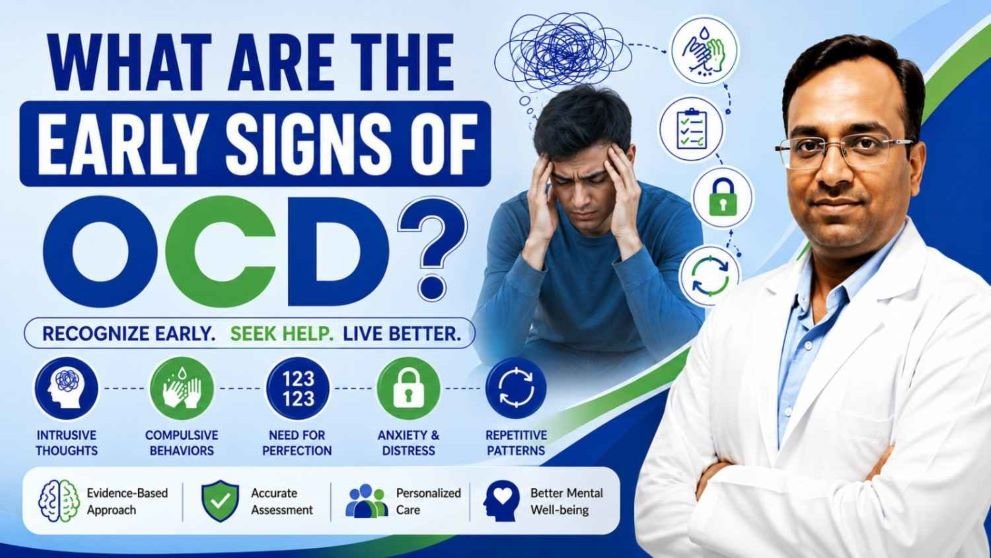
What Are the Early Signs of OCD?
Key Takeaway
Early OCD signs can include intrusive thoughts, repetitive behaviors or mental rituals, excessive doubt, reassurance-seeking, and anxiety when rituals are interrupted. Early recognition is important because persistent symptoms that cause distress or interfere with daily life may require professional assessment and treatment.
OCD and Its Early Signs
Obsessive-Compulsive Disorder (OCD) is a mental health condition in psychiatry characterized by persistent, unwanted thoughts (obsessions) and repetitive behaviors or mental rituals (compulsions). This guide is designed for people who want to understand the early signs of OCD, recognize when symptoms may need professional attention and learn when to consult a mental health professional.
Obsessive-Compulsive Disorder (OCD) brings to mind a person obsessively washing their hands or checking if the door is locked multiple times before leaving the house. These are not untrue sentiments; rather, they only describe a small portion of what OCD is. Before it is revealed by any external sign of the disease, OCD generally starts as an inner, voiceless struggle that takes the shape of compulsive behaviors or mental fixations such as the following:
Because the initial signs of the disease can often be so difficult to recognize, it is often overlooked in young patients, who may simply view it as a strange habit or “stage.” The early signs of the disease need to be detected, because the later you start treatment for OCD the more difficult it will be to treat. Here is a brief on what you can do to identify early signs of OCD.
Emotional Signs
Prior to the rituals becoming apparent, it’s common for OCD to manifest as an emotional undertone. This manifests in the form of an individual appearing more anxious, nervous, and tense than normal without an easily identifiable cause. Some notable examples of emotions that might give clues to an OCD condition include:
- Experiencing constant, persistent, and low-levels of anxiety that do not correlate with the scenario – obsessing over the cleanliness of one’s surroundings or feeling that something is off when in reality nothing is.
- Having feelings of shame about their inability to control their thoughts and knowing that their thoughts are not what really defines who they are as a person.
- Feeling irritable and frustrated whenever there is an interruption in the rituals and/or compulsive acts they do.
- Needing reassurance even though they may already be told the answer such as repetitively asking “Are you sure I locked the door?”
- Fatigue due to coping with the thoughts and rituals all the time.
These emotional symptoms often become apparent long before the rituals are noticed by family and friends.
Behavioral Signs
With OCD progression, the internal anxiety begins to surface through outward behavior. Some of the initial behavioral symptoms are:
- Carrying out certain activities (tapping, touching, arranging) a certain number of times.
- Spending a very long period carrying out mundane activities like dressing up, taking bath, or going out of the house.
- Being highly cautious with some things, people, numbers, places because they generate stress and unease.
- Stress due to the compulsion of checking locks, switches, electrical appliances, and even the compulsion of sending something to someone.
- Having rigid rituals which must be carried out in a certain order, which causes distress if they are not done in the right order.
- Washing hands excessively or cleaning too often.
The important point to note here is that everyone checks locks now and then. The difference between being cautious and having OCD lies in the amount of stress felt when the behavior is disturbed.
Common Obsessive Thoughts
Obsessions are intrusive thoughts, images or urges that continually occupy the mind and are difficult to dismiss. Initially, it’s likely that a person won’t even be aware that they are “obsessions” but rather simply a particularly loud and persistent worry. Typical obsessions are:
- Contamination fears related to germs, dirt or body fluids.
- The fear of hurting oneself or another individual accidentally.
- A preoccupation with symmetry, orderliness, or that everything is “just so.”
- Forbidding, obsessive thoughts regarding religion, sexuality, or morals which are intensely disturbing and abnormal.
- Need to doubt one’s own actions or behaviors (for example, if the door is locked or the stove is turned off).
It should be emphasized that having an occasional unusual thought is entirely human and not unusual. What characterizes the beginning stage of OCD is the frequent occurrence of such thoughts, their intrusive nature, and difficulty in pushing them aside.
Common Compulsive Behaviors
Compulsions are the behaviors or mental rituals that an individual engages in to help alleviate the anxiety arising out of an obsession, or to stop the bad thing from happening. Some common early signs of compulsions are:
- Unreasonably long sessions of washing or cleaning.
- Repeated checking of locks, appliances, homework and text messages.
- Repeating numbers, taps, words in your head till you feel it’s ‘just right’.
- Arranging things until they look perfect.
- Ruminating on your behavior in the past and making sure everything was done well.
- Looking for constant reassurance from parents, partners or peers.
This sense of relief provided by performing the ritual is usually short-lived and the anxiety reemerges again, usually more strongly than before. This is what drives the cycle forward.
Early Signs in Children
The onset of OCD can be during childhood or adolescence, but children do not report the same as adults do. It is usually noticed by teachers and parents who notice changes in behavior of the child, which include the following:
- Repetitive inquiries for affirmation such as, “Am I doing this right?” which go beyond the inquiries of the average child.
- Problems in getting homework done or being prepared for school due to checking and rechecking.
- Emotional upset from interruptions in rituals and routines.
- Avoidance of particular items that have certain textures like not wanting to touch door handles or particular foods.
- Hand washing and refusal to touch anything that is dirty.
- Decline in school performance or refusal to attend school because of time consumption in rituals and fear of “doing something wrong”.
Since children lack the language to express their intrusive thoughts, upset children express themselves through tantrums or other behaviors.
Early Signs in Adults
Whereas in adults, OCD symptoms are usually more concealed, since adults are better at concealing their rituals in public and convincing themselves and others of the reasons behind their actions. Early signs in adults usually include:
- A great deal of time is spent on rituals such as locking doors, cleaning and organizing before being ready to continue.
- Frequent attempts at gaining reassurance from one’s partner, friends, or coworkers regarding choices that have already been made.
- Shunning of certain duties such as driving, cooking, or using sharp objects due to the intrusive fear of hurting someone.
- Inability to concentrate at work due to constant unwelcome thoughts.
- Avoiding social contact to engage in rituals or avoid triggers.
- Increasing irritability, fatigue or depression due to mental exertion from managing the symptoms.
Since adults tend to wait to seek treatment for the fear of embarrassing thoughts or just being unable to “stop,” this is precisely why it’s important to get professional help early on without any judgment.
Signs of OCD by Age Group at a Glance
| Sign Category | Sign Category | In Adults |
| Emotional | Meltdowns, clinginess, distress when routines change | Anxiety, guilt, irritability, reassurance-seeking |
| Behavioral | Repeating actions, avoiding objects, slow at daily tasks | Excessive checking, avoidance of responsibilities |
| Obsessive thoughts | Fear of germs, “not right” feelings, fear of harm to family | Contamination fears, harm-related doubts, moral/religious intrusive thoughts |
| Compulsions | Handwashing, arranging toys, asking the same question repeatedly | Checking locks/appliances, mental reviewing, reassurance-seeking |
| Visible impact | Falling grades, school refusal, tantrums | Missed deadlines, social withdrawal, relationship strain |
Note: This comparison is based on general clinical patterns observed in pediatric and adult OCD presentations and is meant for awareness purposes only, not self-diagnosis.
When Should You Seek Professional Help?
Occasional worrying, being tidy or double checking are all normal parts of daily life and do not require any intervention. There are clear indications when seeing a psychiatrist is necessary:
- The obsessions or compulsions occupy more than an hour in a day.
- The obsessions or compulsions create distress, feelings of guilt, and shame.
- They affect normal functioning – school, work, social interactions, or normal activities.
- The person tries to avoid contact with other people or certain situations due to their fears.
- Reassurance seeking and rituals create problems for family or friends.
- The symptoms last for several weeks and become worse instead of getting better.
These criteria align with the diagnostic guidelines outlined in the DSM-5 (Diagnostic and Statistical Manual of Mental Disorders, 5th Edition) used by mental health professionals worldwide.
The obsessive compulsive disorder is not likely to go away by itself and the symptoms are usually developing further. The good news about this disorder is that it responds well to treatment, both in the form of cognitive behavioral therapy (especially Exposure and Response Prevention) and medication. A professional psychiatrist will evaluate the severity of the problem and will develop the appropriate treatment for the patient, regardless of age.
If you have these symptoms and need to find an experienced psychiatrist in Lucknow who can treat your OCD, Dr. Deeptanshu Agarwal provides psychiatric help at Nirvan Hospital and creates individual treatment programs and therapy.
Final Thoughts
However, the early symptoms of OCD may not be so evident; all they might include is a worrying thought, a trivial ritual or a question that gets asked too often. It is hard to see them and even harder to recognize them. However, the ability to do that in time makes it possible for one to take necessary steps to treat this condition and overcome it more effectively.
If you identify with any of these symptoms and want to change something in your life now, then you may turn to Dr. Deeptanshu Agarwal, a consulting psychiatrist in Lucknow with over a decade of experience in providing evidence-based treatments for mental disorders.
Frequently Asked Question
Where can I get OCD treatment in Lucknow?
Dr. Deeptanshu Agarwal at Nirvan Hospital, Lucknow offers evidence-based OCD treatment including CBT, ERP therapy and medication management for both children and adults.
At what age do early signs of OCD usually appear?
Even though it can affect any age group, the condition normally occurs when the person is aged between 8 to 12 years or late teens to early twenties.
Can early signs of OCD go away on their own?
Involuntary or occasional compulsions may disappear with the passage of time; nevertheless, actual symptoms of OCD are persistent and get worse with time without any treatment. This is why a professional opinion is needed.
Is OCD the same as being a “neat freak” or perfectionist?
No. But the typical orderliness or neatness preferences don’t cause major distress or get in the way of people’s lives. OCD is about intrusive, unwanted thoughts and compulsions that are not based on personal preference and are performed to alleviate anxiety.
How is OCD diagnosed?
A psychiatrist usually assesses symptoms through clinical interviews and standardized questionnaires and also observes the extent to which the thoughts and behaviors impair functioning in daily life, also excluding other disorders that may share symptoms.
What treatments help with early-stage OCD?
Cognitive behavior therapy (specifically CBT and ERP – Exposure and Response Prevention) and medication (in some cases SSRIs) are considered to be first-line treatment options, especially when applied early.