

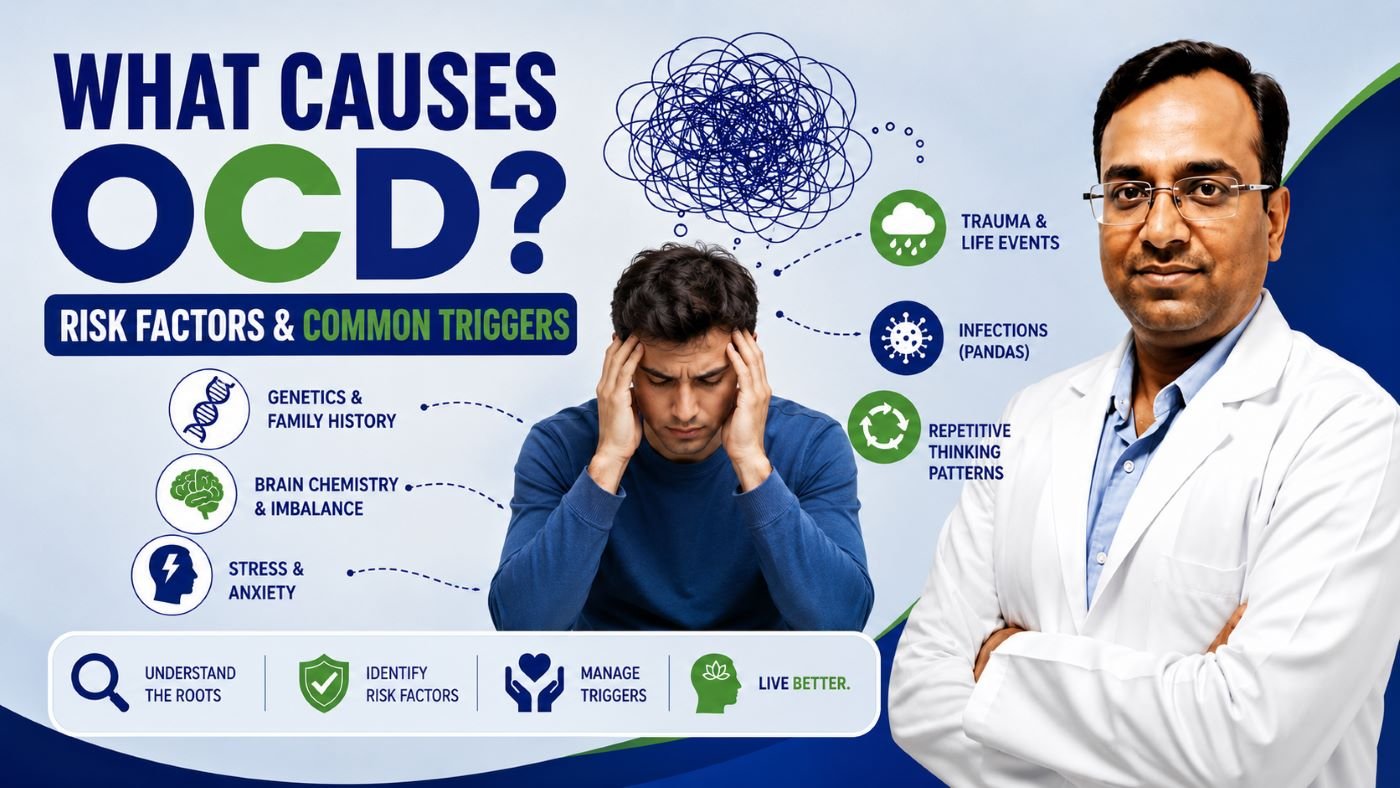
What Causes OCD? Risk Factors and Common Triggers
Key Takeaways
Obsessive Compulsive Disorder stems from a mix of biological, genetic, and environmental factors – no single cause
Family history increases risk but doesn’t guarantee Obsessive Compulsive Disorder will develop
Stress and major life events can trigger or worsen symptoms in those already vulnerable
Sudden-onset OCD in children may be linked to PANDAS (streptococcal infection)
Obsessive Compulsive Disorder rarely resolves on its own – professional treatment significantly improves outcomes
Obsessive Compulsive Disorder, which stands for Obsessive Compulsive Disorder, is one of the most misinterpreted mental disorders in contemporary times. Most individuals associate it with individuals who have excessive hygiene or just like things to be done in a certain way. However, the truth of the matter is that Obsessive Compulsive Disorder is a mental condition that is characterized by intrusive thoughts (obsessions) that compel an individual to engage in specific activities or rituals in order to relieve themselves from the anxiety brought about by those thoughts.
In case you or your loved one has Obsessive Compulsive Disorder or has signs of OCD, the question that immediately arises in the mind is what causes it. The causes vary from one individual to another. They encompass biological, genetic, psychological, and environmental factors among others.
What Is Obsessive-Compulsive Disorder?
Obsessive Compulsive Disorder has two related parts:
1) Obsessions: Recurrent and persistent thoughts, images, or urges that are experienced as intrusive and unwanted (fear of contamination, fear of safety, violent and taboo intrusive thoughts, need for symmetry, etc.)
2) Compulsions: Actions or mental processes that one can perform in repetition and that help relieve the distress related to obsessions (overly washing hands, locking doors repeatedly, counting, mental reviewing, arranging objects)
In the long run, this Obsessive-Compulsive Disorder cycle may occupy a lot of time of an individual and affect his/her work and personal life adversely.
What Causes Obsessive-Compulsive Disorder? The Core Factors
Experts now believe that Obsessive-Compulsive Disorder is not a result of one cause, but a combination of biology and life experiences. Here’s a closer look at the main contributors.
1. Genetics and Family History
There is always a tendency for Obsessive-Compulsive Disorder to be genetically passed down to an individual. This means that where one has a relative suffering from Obsessive-Compulsive Disorder, there is a very high likelihood of one having Obsessive Compulsive Disorder. This does not mean that Obsessive-Compulsive Disorder will be passed on; it simply means that there is a biological predisposition to it.
2. Brain Structure and Chemistry
Obsessive Compulsive Disorder imaging in patients has found abnormalities in certain parts of the brain, especially the orbitofrontal cortex, anterior cingulate cortex, and basal ganglia – sections of the brain concerned with decision making, behavior, and mistakes detection. Imbalance in the level of serotonin, which affects mood and anxiety, is also found in people suffering from Obsessive Compulsive Disorder. This is among the reasons why some antidepressants used in treating Obsessive Compulsive Disorder have been successful.
3. Personality and Temperament
There are certain personality types that are more common among people suffering from Obsessive Compulsive Disorder such as being perfectionist, having excessive desire for control, being very responsible and guilty, and intolerance of uncertainty. These personality types don’t lead to Obsessive-Compulsive Disorder development by themselves; they only increase the threat posed by intrusive thoughts.
4. Learned Behaviour Patterns
In some instances, such behavior may be reinforced over time. The individual carries out a ritual, gets relieved of the anxious feeling temporarily, and his brain learns how to replicate that same action every time anxiety occurs.
5. Autoimmune and Neurological Triggers (PANDAS)
The development of symptoms of Obsessive Compulsive Disorder in children may occur suddenly due to an infection by streptococcal bacteria. This condition is referred to as PANDAS (Pediatric Autoimmune Neuropsychiatric Disorders Associated with Streptococcal infections).This is rare but important for parents to know about when there is sudden onset of symptoms.
Common Risk Factors for Obsessive-Compulsive Disorder
While anyone can develop Obsessive Compulsive Disorder, certain factors increase vulnerability:
| Risk Factor | How It Contributes |
| Family history of OCD or anxiety disorders | Increases genetic predisposition |
| Childhood trauma or abuse | Heightens anxiety sensitivity and need for control |
| Major life changes (marriage, childbirth, job loss) | Can trigger onset in genetically vulnerable individuals |
| Chronic stress | Overloads the brain’s threat-response system |
| History of other mental health conditions | Depression, anxiety, or tic disorders often co-occur with OCD |
| Pregnancy and postpartum period | Hormonal shifts can trigger or worsen intrusive thoughts |
| Perfectionist or highly rigid personality traits | Amplifies distress caused by intrusive thoughts |
| Streptococcal infection (in children) | Linked to sudden-onset OCD (PANDAS) |
Note: Having one or more risk factors does not mean Obsessive Compulsive Disorder will definitely develop – it only indicates increased vulnerability.
Common Triggers That Worsen Obsessive Compulsive Disorder Symptoms
Despite being established, certain factors may lead to Obsessive-Compulsive Disorder flare-ups and increase symptoms in individuals:
- Stressful events – tests, work deadlines, money problems, fights with your partner or friends
- Significant life changes – relocation to another city, changing your job, having kids
- Being ill or worried about your well-being – can make you think that there are contaminations or problems with health
- Lack of sleep – makes it harder for the brain to deal with anxiety and impulses
- Using substances – drinking or taking drugs might lead to worsening of anxiety-driven actions
- Social networks and seeking reassurance online – constantly trying to check something or find an answer can fuel compulsive behavior
Postpartum period – new parents, usually women, may start thinking about possible danger to their baby
Is Obsessive-Compulsive Disorder Only About Cleanliness?
Not necessarily – this is one of the most common misconceptions. Some other forms of Obsessive Compulsive Disorder include:
- Checking Obsessive Compulsive Disorder (locks, appliances, and safety)
- Symmetry and “Just Right” Obsessive Compulsive Disorder
- Obsessive intrusive thoughts of a violent, sexual, or blasphemous nature (Pure-O or “Purely Obsessional” Obsessive-Compulsive Disorder)
- Relationship Obsessive-Compulsive Disorder (doubt about the relationship and/or their partner)
- Obsessive Compulsive Disorder caused by health anxiety
- Hoarding behaviors
All of these subtypes may have different triggers, yet they still follow the same anxiety cycle.
When Should You See a Psychiatrist?
Should these obsessions or compulsions be occupying an hour or more a day, leading to significant distress or hindering your ability to function at school, work, or in relationships, then you need to consult a health practitioner. Obsessive Compulsive Disorder is highly treatable with proper treatment techniques that may include:
- Cognitive Behavioral Therapy (CBT) – particularly ERP technique
- Psychopharmacology – SSRIs and other medications
- Psychodynamic Psychotherapy – helping to deal with deep-seated anxiety and obsessional thoughts
- Advanced treatment like rTMS therapy for select cases of treatment-resistant Obsessive Compulsive Disorder
- Diagnosis and proper treatment can help a lot.
Final Thoughts
Obsessive Compulsive Disorder is neither a flaw in one’s character nor a bad habit that someone just “snaps” out of. Obsessive Compulsive Disorder is a real condition resulting from a true combination of factors such as genetics, biochemistry of the brain, personality type, and life events. The comprehension of the causes of Obsessive-Compulsive Disorder and identification of one’s own risk factors and triggers is the first step towards dealing with this condition.
If you yourself or one of your close relatives have Obsessive-Compulsive Disorder then you should definitely seek assistance. You will get proper treatment and diagnosis after consulting a psychiatrist.
Dr. Deeptanshu Agarwal is a psychiatrist in Nirvan Hospital at Lucknow, India. He has professional experience of over 10 years.
Specializing in Obsessive Compulsive Disorder and other mental health problems, Dr. Deeptanshu Agarwal uses only evidence-based treatment. Contact him today and start your recovery.
Frequently Asked Questions
Can Obsessive Compulsive Disorder develop suddenly, or does it always build up slowly?
Most cases of Obsessive Compulsive Disorder develop gradually, but there are rare cases where – in particular in children after an infection (PANDAS) – that the symptoms can onset suddenly and severely.
Is Obsessive Compulsive Disorder hereditary?
And genes do play a meaningful role. Having a relative with Obsessive-Compulsive Disorder makes it more likely, but does not mean, that the person will develop the disorder.
Can stress alone cause Obsessive Compulsive Disorder?
Stress by itself usually doesn’t cause Obsessive Compulsive Disorder, but it can bring about symptoms in someone who has a genetic or biological vulnerability.
Does Obsessive Compulsive Disorder go away without treatment?
Obsessive-Compulsive Disorder rarely goes away on its own. Symptoms tend to persist or worsen without treatment. Results are vastly better with professional assistance.
Can adults develop Obsessive Compulsive Disorder for the first time later in life?
Yes. While Obsessive Compulsive Disorder usually begins in childhood or adolescence, it may also develop at a later stage, often in response to major life stressors or hormonal shifts.