

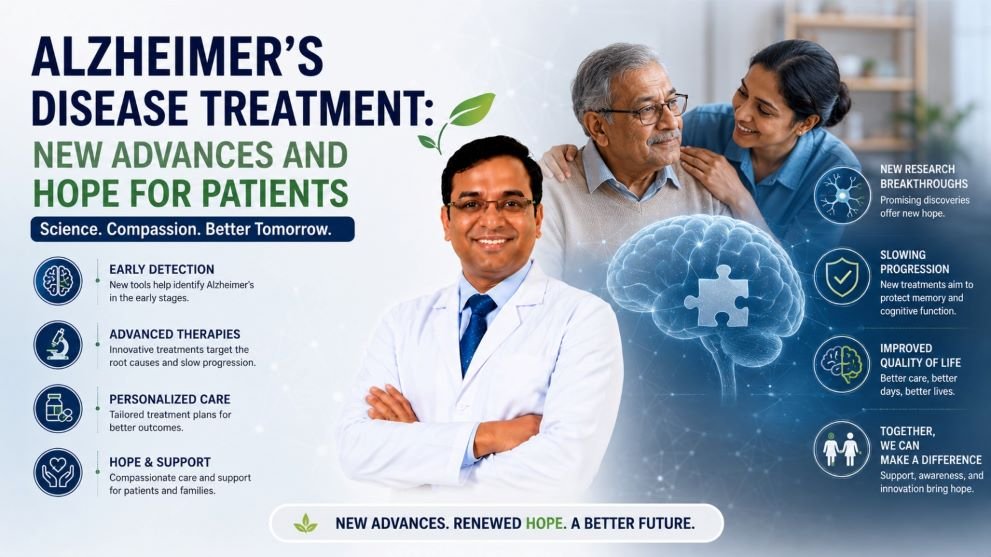
Alzheimer’s Disease Treatment: New Advances and Hope for Patients
There is a distinct type of loss that does not appear at the same moment. When your mother stares at you and pauses before saying your name, that’s when it begins. In the same manner that someone would tell a story for the first time, your father tells you the same one he did earlier today. In the calm realization that the other person is still there, still breathing, and still smiling, but that something essential is leaving and you don’t know how to keep it.
This is not a piece that is high in frigid data and medical terminology. It is written for actual individuals navigating one of the most difficult emotional events a family may go through. It will discuss what Alzheimer’s disease is, what treatments are now available, what incredible new medical advances are occurring, and, to be honest, why there is more hope now than there ever has been before.
What exactly is Alzheimer’s Disease?
Alzheimer’s disease is a condition that progressively worsens and impairs memory, thinking and everyday tasks. It makes up 60–80% of all dementia cases globally and is the most common kind of dementia.
The condition manifests itself from the inside out. Over time, strange protein deposits known as amyloid plaques grow in between brain cells; twisted fibers known as tau tangles develop within them. Chronic inflammation, interference with intercellular communication and eventually the death of brain cells are all caused by these plaques. The brain begins to atrophy as the damage increases. It’s moving at a snail’s pace. It is endless. For a very long time, there weren’t many answers that medicine could provide.
What Causes It, and Who is Most at Risk?
Age is the factor that poses the most danger. Most Alzheimer’s patients are over 65 years old. But just getting older does not bring it on. Consider age as the stage on which the disease acts rather than the director.
Additional risk factors include a family history of Alzheimer’s, especially one with a gene variant called APOE-e4, a past of major head trauma, poorly managed heart disease, high blood pressure, or diabetes; chronic sleep deprivation; extended social isolation; and low levels of cognitive involvement across a lifetime. Women’s diagnoses exceed those of males. Researchers are still looking into why, while both hormonal and longevity elements likely have some influence.
One significant thing to remember: Alzheimer’s is not unavoidable. Many people with risk factors never get it. Many people without clear risk factors also do. Research is extremely important since the image is intricate.
What Does Alzheimer’s Look Like At Each Stage?
In the early stage, the changes are minor enough that they are simple to explain away. Losing track of recent talks. losing tabs on appointments. Having trouble locating a word that used to come naturally. Not being able to follow steps and misplacing goods. a little change in attitude, more withdrawn, more concerned. Most people at this level still live on their own, still work, still quite much themselves.
In the moderate stage, the gaps get tougher to cover over at the moderate stage. One loses more memory. Familiar faces could get increasingly difficult to identify. Time, location, and daily activities cause more uncertainty. Dealing with money, following recipes, or negotiating a commute becomes really challenging. Behavioral changes can cause suspicion, agitation, depression, or sleep issues that tire down every member of the house.
In the advanced stage, The individual in the advanced stage needs total help with daily tasks including dining, dressing, grooming, mobility. Verbal communication is really constrained. The link to the present gets weak. Still, it’s important to note that episodes of recognition, warmth, and emotional presence still might burst through at least often when least expected.
Why Does Early Diagnosis Matter So Much?
Time is the one thing you can’t get back. The newer therapies, the ones that are really altering possibilities, function optimally in the earliest phases before noticeable brain damage has built up. Early Alzheimer’s diagnosis gives families more time to prepare instead of rush, more treatment options, more time for the person affected to help to make decisions. If something doesn’t seem right, believe your gut feeling. Having it checked is always wise.
Current Alzheimer’s Disease Treatment Options
As of now, there is no treatment. That is the honest truth and it ought to be told just as it is. But without a cure, one can still take action. Those two things are separated by a great distance, and much meaningful life occurs in between.
Medications That Help
Right now, two classes of medications are employed to control Alzheimer’s symptoms.
By keeping acetylcholine levels a chemical messenger that is reduced in Alzheimer’s-affected brains, cholinesterase inhibitors including donepezil, rivastigmine, and galantamine help to preserve them. They do not halt the disease. But for many patients, that extra window of clarity is priceless, and they can help to maintain memory and cognitive ability for longer.
Memantine acts via a different mechanism, guarding brain cells against a kind of chemical overload. Most often utilized in moderate to severe phases, sometimes with cholinesterase inhibitors. Together, these drugs enable many individuals to keep their quality of life and skills for longer than they would without them.
Therapies That Go Beyond Medication
Cognitive stimulation therapy- Structured, engaging group activities designed to exercise memory and thinking has shown real benefits not just for mental sharpness but for mood and sense of purpose. Many patients genuinely enjoy these sessions. They are social, stimulating and grounding.
Reminiscence therapy- Uses photographs, music, familiar objects and stories from the past to help patients reconnect with their own histories. It can be deeply moving both for the person and for the family members involved. Memory of the distant past often remains more intact than recent memory, and this approach builds on that.
Behavioral approaches- Address the difficult symptoms of agitation, sleep problems, depression, repetitive behaviors with structured techniques that can reduce distress without jumping to medication.
Consult for advanced Alzheimer’s care today!
Lifestyle Changes That Actually Move the Needle
This is not about promoting health. The proof offered here cannot be contested.There are many studies that have shown that some moderate physical activity such as walking a few times a week can help improve cognitive performance and increase cerebral blood flow. The health of the brain appears to benefit greatly from a Mediterranean-style diet, which is high in fish, olive oil, whole grains, and vegetables . Many individuals overlook the need of obtaining enough sleep. The brain actively removes waste materials such as amyloid during deep slumber. Social relationships and cognitive engagement are not extra options in therapy.
These changes are more than just background noise for someone who is just getting started. They are medicines that are effective.
Recent Advances in Alzheimer’s Disease Treatment
Here is where the story begins to genuinely change.
For decades, every major Alzheimer’s drug trial failed. The scientific community kept searching for the lock that the key would fit and kept coming up short. Those failures were heartbreaking for researchers, for patients and for families who had hoped.
And then, something shifted.
Blood Tests That Can See the Future
One of the most silently transformational modern advancements is no drug at all. It’s a blood test. Researchers have created blood-based biomarker assays able to identify high amyloid and tau proteins, the biological signatures of Alzheimer’s years, often over ten years before any symptoms show themselves. Once requiring an expensive PET brain scan or a lumbar puncture, a blood draw can now identify something.
This changes the entire timeline. Instead of diagnosing Alzheimer’s when it is already well advanced, doctors may soon be able to identify it in the silent phase when intervention is most powerful and the brain still has the most to protect.
Brain Imaging: View more precisely
Modern PET imaging can now map amyloid and tau deposits in the living brain with amazing precision. Advanced MRI methods track changes in brain volume over time, enabling doctors to follow disease development and evaluate the degree of success of a therapy. These resources are changing Alzheimer’s care from a synthesis of knowledge into something far more like a science.
Personalized Medicine:
Taking care of the person, not just the diagnosis. Not everyone’s Alzheimer’s presents identically. Individual differences exist in genetic profiles, biomarker patterns, age of beginning, and rate of advancement. The move toward customized medicine, wherein a patient’s particular biological profile informs treatment decisions, is progressively influencing how the best institutions approach Alzheimer’s treatment. Medicine is moving in this path, therefore Alzheimer’s therapy is following along.
The Importance of Early Intervention
The most exciting treatments now available and the ones in trials work best when the disease is caught before major damage accumulates. The sooner someone is examined, the more choices are available. The sooner a family starts planning, the more real option there is in the decisions ahead and the less crisis-management. Get help if you find ongoing memory problems that appear to be worsening over time. If familiar chores like managing invoices, following a recipe, or negotiating a familiar path are getting truly hard, look for help. Seek evaluation if someone close to you has expressed concern.
Memory problems have many possible causes, not all of them Alzheimer’s. Some are treatable and completely reversible. But the only way to know is to ask.
Expert Alzheimer’s Care with Dr. Deeptanshu Agarwal
Facing a question about memory whether your own or someone you love is not something to navigate without support from someone who genuinely understands these conditions. Experienced psychiatrist Dr. Deeptanshu Agarwal focuses on cognitive disorders and memory-related disorders. His method starts where it ought to: the individual. Not only their results but also their background, daily life, worries, and top priorities.
He creates personalized treatment programs for patients with Alzheimer’s based on the most recent research on current drugs, behavioral techniques, lifestyle advice, and where suitable paths toward new treatments and clinical trial participation. Care is not fixed and passed over; Through regular evaluation and honest communication, it changes along with the patient’s demands.
Final Thoughts
One of the most difficult challenges for healthcare still is Alzheimer’s disease. It takes people gently, it demands a great deal of the surrounding families, and it has resisted treatment for far too long.
Still, we have evolved. We are nowhere near our level of five years ago.
If memory issues are affecting your life, whether for yourself or someone you care about, kindly do not carry that burden by yourself. Look for a qualified assessment. Ask your questions. Obtain the data required to guide wise judgments. Early action is now the most potent tool you have.
You do not have to handle this on your own. Furthermore you need not confront it hopelessness.
Frequently Asked Questions (FAQs)
What is the most effective treatment for Alzheimer’s disease?
There is no cure for Alzheimer’s disease, but treatments, which include medications, cognitive therapies and lifestyle interventions, can help manage symptoms and improve quality of life. New therapies also hold promise in slowing disease progression.
Are there any new advances in Alzheimer’s disease treatment?
Yes, recent advances include anti-amyloid medications, early diagnostic tools and personalized treatment approaches. Researchers are also exploring gene therapy, immunotherapy and innovative drug combinations to improve outcomes for patients.
Can Alzheimer’s disease be slowed down?
While Alzheimer’s cannot yet be completely stopped, certain treatments, healthy lifestyle habits, regular exercise, mental stimulation and early intervention may help slow cognitive decline and maintain independence for longer.
Who is eligible for the latest Alzheimer’s treatments?
Eligibility depends on factors such as the stage of the disease, overall health and specific medical evaluations. Patients with early-stage Alzheimer’s are often the primary candidates for newer treatment options.
What lifestyle changes can help people with Alzheimer’s disease?
A balanced diet, regular physical activity, quality sleep, social engagement and brain-stimulating activities can support cognitive health and complement medical treatment for Alzheimer’s disease.